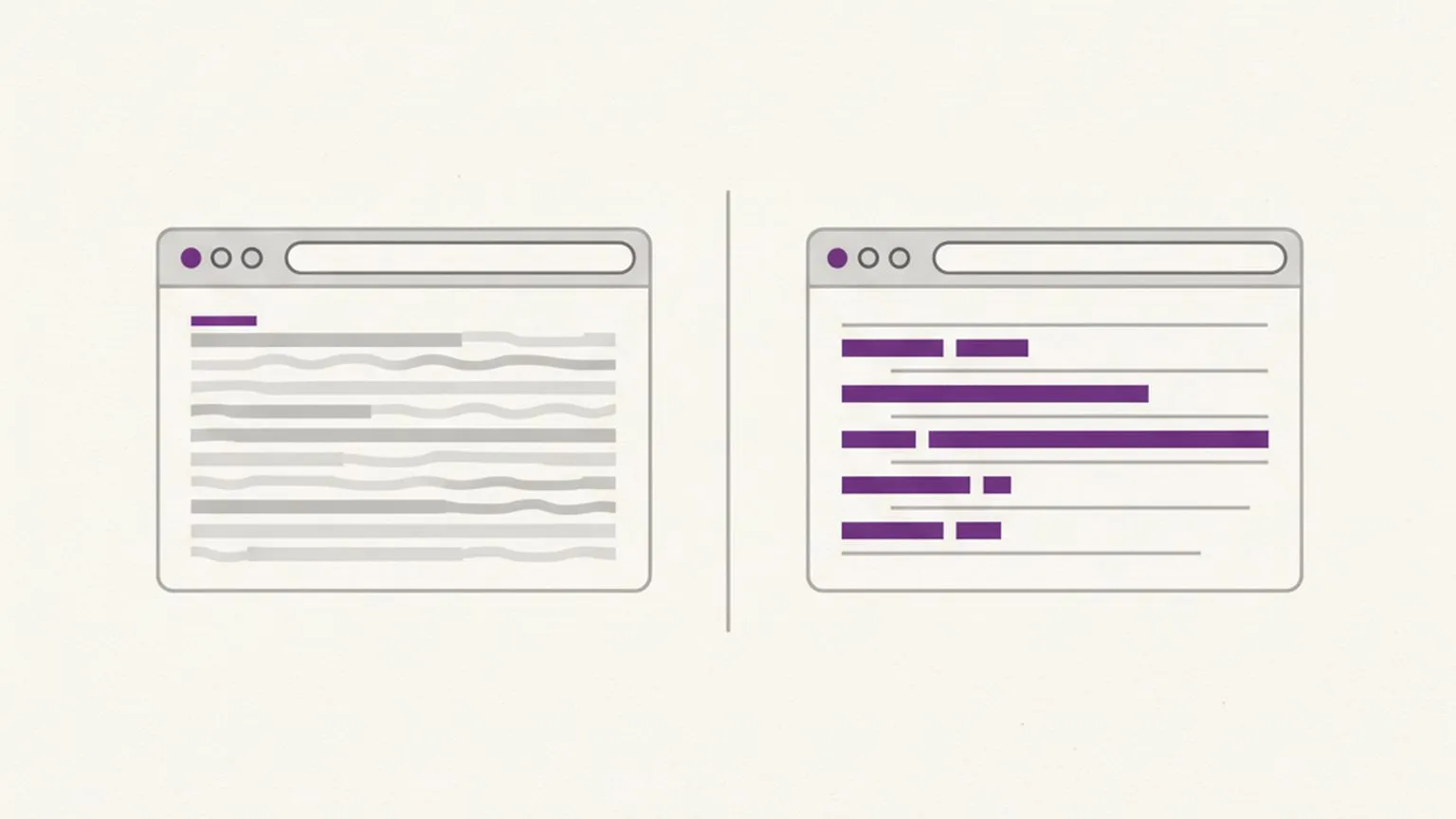
Cloudflare Markdown for Agents Explained
AI assistants are becoming a real discovery layer. Buyers are starting with questions like "best platform for X" and "top alternatives to Y", and they trust the answers enough to act on them.
Cloudflare noticed the shift and launched Markdown for Agents. It is a smart move. It makes pages cheaper to consume by converting HTML into markdown when an AI agent requests it using standard HTTP content negotiation. The agent sends an Accept: text/markdown header, Cloudflare converts the HTML on the fly, and returns markdown.
Markdown improves readability and efficiency. It does not automatically make you recommendable.
What Markdown for Agents actually does
Markdown for Agents is a delivery optimization layer. It serves a markdown variant of your page only when the requester asks for it. Browsers still get normal HTML. Agents can request markdown and receive a cleaner version that is easier to parse. This is done with content negotiation, and responses are typically cached separately using a Vary: accept header.
- It reduces parsing overhead: less HTML noise, cleaner content for agents.
- It is opt-in on Cloudflare: enabled per zone and served on request.
- It is still your same content: just formatted differently.
If your page says "We help businesses grow", markdown makes it cheaper to read, not more specific.
The missing layer: what AI agents need to recommend a business
Recommendation requires more than text. When an assistant answers "best tools" or "top vendors", it needs structured facts it can trust and compare. Most websites do not expose those facts in a deterministic, machine-readable way.
- Structured product or service catalogs: clear offerings, attributes, and optionally pricing ranges.
- Intent-based FAQs: questions that match how buyers actually ask.
- Trust signals: testimonials, reviews, certifications, case studies, and proof.
- Category taxonomy: so an agent can compare you to alternatives correctly.
- Schema-like structure: so machines can parse meaning without guessing.
Readable is not the same as recommendable. Recommendation needs structure.
Format vs structured discovery: the difference
This is the simplest way to think about it. One approach makes your existing pages easier to consume. The other creates a dedicated, machine-readable layer that exposes business context in a predictable format.
| Capability | Markdown for Agents | LightSite Discovery Layer |
|---|---|---|
| Token efficiency | Yes (markdown variant) | Yes (compact structured endpoints) |
| Works on existing HTML | Yes (converts pages) | No (generates new structured context) |
| Creates new structured data | No | Yes (business, products, FAQs, proof) |
| Dedicated machine endpoints | No (serves converted page) | Yes (example: /business, /products, /faq, /testimonials) |
| Crawler analytics | Mostly aggregate network-level visibility | Per endpoint, per bot, per session behavior |
| Bot behavior intelligence | No | Yes (session tracking and structured journey measurement) |
| Brand visibility tracking | No | Yes (brand audit and position intelligence) |
Better together: the ideal stack
This is not either-or. In an ideal setup, you use markdown delivery for efficiency and a structured discovery layer for clarity and recommendations.
- Cloudflare Markdown for Agents: makes your marketing pages and docs cheaper for agents to parse.
- LightSite Discovery Layer: exposes your business identity in structured formats that agents can trust and compare.
If you only optimize HTML, you may become more readable. If you add structured discovery, you become more recommendable.
What this means for your business
Most teams are still thinking in clicks. AI discovery is different. Your job is to make it easy for machines to build a correct picture of who you are, what you offer, and why you are credible. To learn more, read our guide on how to optimize your website for AI search, or run a free GEO check to see where you stand. Markdown helps with efficiency. Structure helps with certainty.
If you want to see where you stand, you can run a quick readiness check. If you want to move from readable to recommendable, the fastest path is to publish a structured layer that covers your business context, offerings, proof, and buyer questions.
Want a simple next step?
Start by mapping the 20 to 50 questions you want to be recommended for, then expose the answers and your business facts in consistent machine-readable formats. That is the core of structured discovery.