How to measure performance in AI search reliably.
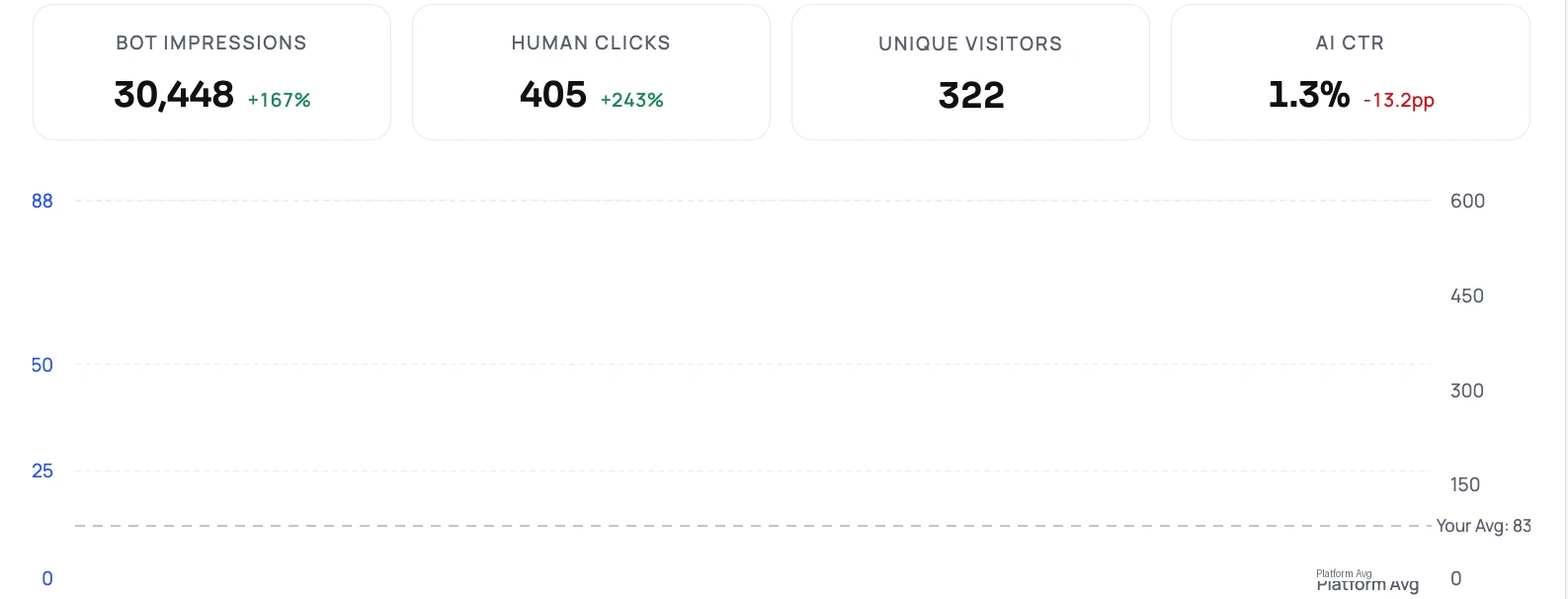
Share of voice and mention tracking is what everyone does. But LLM answers are non-deterministic — they change every time you ask. LightSite sits on your website and measures two events that actually happened: AI bot visits, and human visits from AI assistants. Together they give you a metric you can trust — crawl-to-visit ratio.
Two events you can actually count
AI bot visits. When someone asks ChatGPT, Claude, Perplexity, or Gemini about your category, the assistant often verifies a fact by fetching your site. GPTBot, ClaudeBot, PerplexityBot, and Google-Extended each show up in your logs. Every hit is proof you were considered.
Human visits from AI assistants. After the assistant answers, some users click through. They arrive with a referrer that ties back to the assistant. Standard analytics miss most of these because the referrer is stripped or classified as "direct".
The metric: crawl-to-visit ratio
Crawl-to-visit ratio (sometimes called AI CTR) = AI-referred human visits ÷ AI bot requests. It compares fetches with visits over the same period. It is not answer CTR: answer impressions are only reported by the AI platforms themselves. Deterministic, because both sides are events you can count.
What our data tells us about what works
- AI visitors land on answer-first pages — comparisons, use cases, pricing explainers, alternatives — not on the homepage.
- Reddit and LinkedIn campaigns move AI discovery bots roughly 37% harder on average than comparable PR-led campaigns.
- High bot activity with flat human AI clicks means you were considered but not recommended — a trust or positioning gap.
FAQ
Why isn't share of voice enough? LLM answers are non-deterministic. The same prompt can return a different answer based on model version, timing, personalization, and retrieval. Mention counts are directional, not attribution.
What are AI bot requests? Verified AI bot sessions on your website — GPTBot, ClaudeBot, PerplexityBot, Google-Extended, and other AI fetchers.
What counts as a human AI visit? A real person arriving from ChatGPT, Claude, Perplexity, Gemini, or Google AI Overviews.
How is the crawl-to-visit ratio calculated? AI-referred human visits divided by AI bot requests, normalized by bot session, platform, page type, and time window.
Does more bot traffic always mean better visibility? No. More bot requests show more identifiable site access, not whether an answer used your content. AI-referred visits show that people followed links from assistants, not necessarily a recommendation.